
How Industrial Welding Can Contribute to Achieving Emergence.
When talking about sustainable development we think of technological developments and capacity building. Growth and development is based on two major pillars: the creation of goods and services. This production of goods and services is based on the transformation of products in order to give them added value or the sale of the expertise which is activated on the development and design of projects for the benefit of internal or external partners. These two elements are crucial for development because it attracts investment.
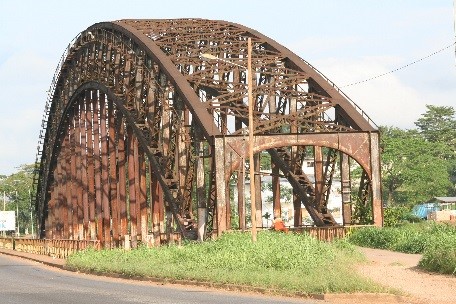
For the realization of structuring projects; heavy machinery such as excavators and lifting cranes are essential. Population growth and the need for urban and inter-urban public transport are increasingly felt. Means of road, river and rail transport will have to be increased by 2035. A significant number of jobs could come from the construction of certain means of transporting people and goods in Cameroon, such as wagons (rail transport). , assembly or manufacturing lines for vehicles, bicycles, motorcycles, bridges, homes. In terms of housing, although concrete meets the need, it should however be noted that its limitation in terms of the size and strength ratio of the structure. Steel structures have practically the same strength as concrete structures and offer more flexibility in terms of design and space management. One of the most tangible examples is this Edea bridge inaugurated in 1911 and which looks great more than a century after its opening.
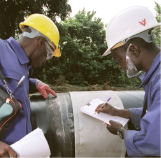
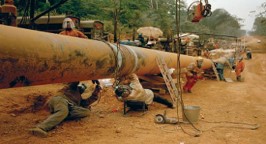
To meet this demand for equipment and skills, mechanical engineering professions in general and welding in particular are essential to meet the demand for the next vast demand for skills from industries and service offerings. In order to avoid the sudden inconvenience during the vast Chad-Cameroon pipeline project where none of the best welders in Cameroon were able to pass the qualification test required by the standards for the execution of such a task.
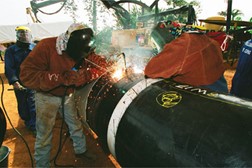
The mechanical engineering professions and welding in particular constitute a vast area of job creation for sustainable development. Jobs in this sector vary from designers, designers or builders, to inspectors and maintainers. The projects are numerous and cover all areas, factories, energy (solar, hydro, wind), homes, vehicles for transporting goods and people, public works and mining equipment, infrastructure road, sports and school, hospitals. It is therefore essential, if not imperative, to strengthen the capacities of young people whose dynamism and talent are often diluted in distant objectives while the need for competence and real and effective development is within their reach.